Showing posts with label unexplained. Show all posts

Saturday, 28 March 2026

The Scrapfaggot Witch Stone of Great Leighs, Essex.

Great Leighs, October 1944.

The second world war had been raging for five years and the allied liberation of Europe was into its fourth month, rural England was awash with military traffic, the heavy machinery of war heading south.

Unfortunately many of the roads were not up to the job, so many a bulldozer was employed to widen the thoroughfares to enable the passage of large and wide vehicles. Great Leighs in Essex was no exception, a US Army bulldozer clearing a section Dratchett Lane managed to dislodge a stone on the side of the road close to the St. Annes Castle pub on Scrapfaggot Green.

This was not good, that stone was there for a reason. According to the Sunday Mirror of the 8th October 1944;

"Two hundred years ago a witch was burned at the stake at the crossroads still known as Scrapfaggot Green, though there is no green there now. She was buried under the ashes of the fire that burned her, and a great stone was placed over her breast to hold her down. And for 200 years there she lay, untroubled and untroubling.

St. Annes Castle Pub (now just The Castle) Witch Stone on the right.

But war swept through the village, along Dratchett Lane and over the crossroads. The narrow, and winding lane would not take heavy traffic. So a bulldozer widened it - and brushed the Witch Stone aside."

Unless this witch had committed treason or had murdered her husband through witchcraft she would not have been burned at the stake, hanging was the accepted form of execution for witchcraft in England, however, scrapfaggot could be a corruption of scratchfaggot meaning helper of the Devil. Be that as it may, strange things were afoot in Great Leighs.

Sunday Mirror - 8th October 1944;

"It was from that moment that the people of Great Leighs date the strange happenings in the village. Now there's hardly a man or woman who has not some story to tell of happenings that don't fit in with ordinary common sense.

Councillor Arthur Sykes, Chief Warden, and village leading light, told me: 'Every day I hear of new mischief in the village. Alf Quilter, the shepherd will tell you of sheep straying from his fields where there is no hurdle out of place or a hole in the hedges big enough for a rabbit to run through.

Great Leighs in the 1940s

People have told me of hearing the church bells being rung at midnight. Yesterday the old church clock was found to be two hours slow, and I don't remember it being wrong before."

Councillor Sykes is no superstitious Essexman, he is a hard headed Lancashireman. 'I don't believe in witches,' he says, 'but then my great grandad didn't believe in radio. He'd have thought I was daft if I'd told him that a man could tune into a little box in America and be heard in Blackpool.

No I don't believe in witches - but I've got to admit there have been strange happenings here since that old stone was shifted.'"

Following this interview the "hard headed Lancashireman" found that his geese had disappeared into thin air! Other strange occurrences were some long heavy scaffolding poles had been moved and scattered around like twigs, some painter and decorators tools, paints, pots and brushes were gone, later they were found under a bed at the top of some rickety stairs in an attic. 

A dead chicken with it's neck twisted was found in a water butt, the local vicar scoffed at this saying it was the work of an animal, then he fell over a stone that was in his way, the stone was not there before, it had recently been moved there, it took three men to lift it away and no one had a clue as to where the stone had come from.

After a calm and still night farmer Ernest Withen said the following morning his haystacks were found "tumbled and spread around his yard," his carts had all been turned around in their sheds, something that took several men half an hour to put right.

Back in London these strange happenings were related to the paranormal investigator Harry Price, Price was famous for his investigations into the haunting of Borley Rectory.

Harry Price had a theory;

"It had been proved to the hilt that poltergeists exist. In my book 'Poltergeist Over England' I have listed over 500 cases of such spirits tricks. Many of them have been put down to the influence of witches.

I have several stories like yours. The spirit usually confines itself to one house, but there have been cases before of a whole village being affected."

Well that's that cleared up! The good folks of Great Leighs and Harry Price decided on a direct approach, they had the stone put back.

Sunday Mirror - Sunday 15th October 1944;

"It was partly public opinion and partly the advice of Mr Harry Price that led to this strange little ceremony. The villagers, led by the Chairman of the local Council, went in a body to the bleak cross roads and pushed and tugged the two ton monument back into place - just as it had been when their forefathers burned the old witch in the 17th century.

'That ought to keep the cunning little old woman comfortable,' said Bill Waver with a sigh of relief. Only the previous day the witch had had a final fling. The victim was Mr Conrad Moth, who found his rabbits roosting in the chicken house with the hens.

Although Mr Price doesn't altogether subscribe to the theory that the witch herself came out at midnight to push over a farmer's hayricks, to let sheep and cattle stray, or to dump chickens in water butts, he believes that the moving of the stone and the emotion it aroused may have loosened a mischievous spirit - or poltergeist - in the neighbourhood.

As Shepherd Alf Quilter said, as he watched the ceremony 'I reckon the witch must have been at home when we put her front door back' for today it is all quiet in Scrapfaggot Green."

So who was this witch? According to Mr R. J. Thompson's article "The Witch Hunter" in the Essex Newsman of Tuesday 27th February 1945, she was perhaps one of the poor souls who met her end at the hands of the infamous Matthew Hopkins at Chelmsford in July 1645.

After this trial 15 women were executed, many more men and women were imprisoned in Chelmsford Castle accused of witchcraft, all on the flimsiest and down right far fetched of evidence.

There was an interesting article in the Perfect Occurrences of Both Houses of Parliament and Martiall Affairs in August 1646, that stated;

"From Hartford, letters tell us that two were condemned for Witches, who should have been executed the last Saturday, but were repreaved in regard that some had suppositions of better things towards them, some feared the Witchtakers seek the price of blood more than to discover Witches, which is a fearful thing if true, as some were hanged at Chelmsford in Essex."

Such rough justice would make a poltergeist of the best of us. The events that year were very prankish, and no doubt a hoax was being perpetrated, could the culprits be found at the nearby US Army base, or local wags out for some fun, we will probably never know.


Thursday, 5 February 2026

The Haunting of Borley Rectory.

The uncanny experiences at Borley Rectory, Essex, can be dated through the British press to 1929 and a series of articles published in the Daily Mirror.

Daily Mirror - Monday 10th June 1929;

"Ghost Visits To A Rectory.

Tales of a Headless Coachman and a Lonely Nun.

The Elopers.

Mysterious Happenings on Site of Old Monastery.

Ghostly figures of a headless coachman and a nun, an old time coach drawn by two bay horses, which appears and vanishes mysteriously, and dragging footsteps in empty rooms. All these ingredients of a first class ghost story are awaiting investigation by psychic experts near Long Melford, Suffolk.

The scene of the ghostly visitations is the rectory at Borley, a few miles from Long Melford. It is a building erected on the part of the site of a great monastery which, in the middle ages, was the scene of a gruesome tragedy.

Borley Church

The present rector, the Rev. G. E. Smith, and his wife, made the rectory their residence in the face of warnings by previous occupiers. Since their arrival they have been puzzled and startled by a series of peculiar happenings which cannot be explained and which confirm the rumours they heard before moving in.

The first untoward happening was the sound of slow, dragging footsteps across the floor of an unoccupied room. Then one night Mr Smith, armed with a hockey stick, sat in the room and waited for the noise. Once again it came - the sound of feet in some kind of slippers treading on the bare boards.

Mr Smith lashed out with his stick at the spot where the footsteps seemed to be, but the stick whistled through the empty air, and the steps continued across the room.

Then a servant girl, brought from London, suddenly gave notice after two days' work, declaring emphatically that she had seen a nun walking in the wood at the back of the house.

Finally comes the remarkable story of an old fashioned coach, seen twice on the lawn by a servant, which remained in sight long enough for the girl to distinguish the brown colour of the horses.

Headless Coachman.

The same servant also declares that she has seen the nun leaning over the gate near the house. The villagers dread the neighbourhood of the rectory after dark, and will not pass it.

Peculiarly enough, all these 'visitations' coincide with the details of a tragedy which, according to legend, occurred at the monastery which once stood on this spot.

A groom at the monastery fell in love with a nun at the nearby convent runs the legend, and they used to hold clandestine meetings in the wood on to which the rectory now backs. Then one day they arranged to elope, and another groom had a coach waiting in the road outside the wood, so that they could escape. 

From this point the legend varies. Some say that the nun and her lover quarreled, and that he strangled her in the wood, and was caught and beheaded, with the other groom, for his villainy. The other version is that all three were caught in the act by the monks, and that the two grooms were beheaded, and the nun buried alive in the walls of the monastery.

The previous rector at Borley, now dead, often spoke of the remarkable experience he had one night, when, walking along the road outside the rectory, he heard the clatter of hoofs. Looking around, he saw to his horror an old fashioned coach lumbering along the road, driven by two headless men."

Bizarre stuff indeed, the next day another thrilling installment.

Daily Mirror - Tuesday 11th June 1929;

"Mystery light in Haunted Wood.

Rector Joins in Quest for Rectory 'Ghosts.'

Eerie Vigil.

Rev. G. E. Smith


'Ghost laying,' to amateurs, is a nerve wracking business. With a Daily Mirror photographer, I have just completed a vigil of several hours in the 'haunted' wood at the back of Borley Rectory, a few miles from Long Melford.

This wood, and the whole neighbourhood of the rectory, is supposed to be haunted by the ghost of a groom and a nun who attempted to elope one night several hundred years ago but were apparently caught in the act.

Although we saw only one of the manifestations which have, according to the residents, occurred frequently in recent years, this by itself was peculiar enough.


The Rector Volunteers.

It was the appearance of a mysterious light in a disused wing of the building - an appearance which simply cannot be explained , because on investigation of the deserted wing it was ascertained that there was no light inside - although the watchers outside could still see it shining through the window!

When we saw the mysterious light shining through the trees we suggested that somebody should go into the empty wing and place a light in another window, for the sake of comparison. 'You go,' we said to each other, and finally the Rev. G. E Smith, the rector, who does not believe in ghosts, volunteered to do it.

Sure enough, the second light appeared and was visible next to the other, although, on approaching close to the building, this disappeared, while the rectors lamp still burned. Then we left alone to probe the mysteries of the haunted wood.

The 'Apparition.'

Queer rustling noises, the sighing of the wind in the trees, the swish of disturbed dead leaves, all worked on our frayed nerves.

Then we had a terrible shock. Staring at a clump of trees, I distinctly saw a white figure flitting about in the gloom. Seizing my companion's arm, and wondering whether I should run forward or back, I stared at the apparition while the photographer frantically attempted to focus his camera, let off a flashlight, throw off any detaining hand, and erect his tripod all at once.

He failed miserably, but by the time he had disentangled from the legs of his tripod, and picked up scattered pieces of camera, I had seen the joke. For the 'apparition' was the rectory maid, coming to ask us if we would take coffee.

Then, when the maid had gone, stillness again, until, after having examined numerous tree stumps, which looked, at a distance, rather like nuns, we decided to abandon the vigil."

In the next installment, the news correspondent brings in the expert. 

Daily Mirror - Wednesday 12th June 1929;

Haunted Room in a Rectory.

Laying The 'Ghost.'

Psychic Expert to Investigate a Suffolk Mystery.

"One of the leading British psychological experts is to investigate the mystery of the 'ghost' of Borley Rectory, Suffolk.

Harry Price and Friend

In an effort to lay the ghost by the heels, and either prove or disprove its existence, Mr Harry Price, honorary director of the National Laboratory of Psychic Research, is to conduct the investigation. Mr Price is famous in this country and in America for his research work and his exposures of exhibitions of psychic 'phenomena.'

Striking confirmation of the weird experiences of the present and past occupants of the rectory is forthcoming from Mrs E. Myford, of Newport, Essex. In a letter to the Daily Mirror Mrs Myford reveals that forty three years ago, when she was a maid at the rectory, similar phenomena were quite openly discussed in the rectory and neighbourhood.

'Much of my youth was spent in Borely and district, with my grandparents,' writes Mrs Myford, 'and it was common talk that the rectory was haunted.' 

'Many people declared that they had seen figures walking at the bottom of the garden. I once worked at the rectory, forty three years ago, as an under nursemaid, but I only stayed there a month, because the place was so weird.'

Something In Slippers.

'The other servants told me my bedroom was haunted, but I took little notice of them because I knew two of the ladies of the house had been sleeping there before me. But when I had been there a fortnight something awakened me in the dead of night. Someone was walking down the passage towards the door of my room, and the sound they made suggested that the were wearing slippers.

As the head nurse always called me at six o'clock, I thought it must be she, but nobody entered the room, and I suddenly thought of the 'ghost.' The next morning I asked the other four maids if they had come to my room, and they all said they had not and tried to laugh me out of it.

Borley Rectory Drawing Room

But I was convinced that somebody or something in slippers had been along that corridor, and finally I became so nervous that I left. My grandparents would never let me pass the building after dark, and I would never venture into the garden or the wood at dusk.'"

The vigil of the Psychic Researcher.

Daily Mirror - Friday 14th June 1929;

Weird Night in 'Haunted House.'

Strange Rappings.

"There can no longer be any doubt that Borley Rectory is the scene of some remarkable incidents.

Last night Mr Harry Price, director of the National Laboratory for Psychical Research, his secretary, Miss Lucy Kaye, the Rev. G. E. Smith, rector of Borley, Mrs Smith and myself were witnesses to a series of remarkable happenings.

All these things occurred without assistance of any medium or any kind of apparatus, and Mr Price, who is a research expert not a spiritualist, expressed himself puzzled and astonished at the results. To give the phenomena a thorough test, however, he is arranging for a seance to be held in the rectory with the aid of a prominent London medium. 

The first remarkable happening was the dark figure I saw in the garden. We were standing in the summer house at dusk watching the lawn, when I saw the 'apparition' which so many claim to have seen, but owing to the deep shadows it was impossible for one to discern any definite shape or attire.

Sunday Sun (Newcastle) - Sunday 22nd December 1929 

Falling Glass.

But something certainly moved along the path on the other side of the lawn, and although I immediately ran across to investigate, it had vanished when I reached the spot. Then, as we strolled towards the rectory discussing the figure, there came a terrific crash, and a pane of glass from the roof of a porch hurtled to the ground.

We ran inside and upstairs to inspect the rooms immediately over the porch, but found nobody.

A few seconds later we were descending the stairs, Miss Kaye leading and Mr Price behind me, when something flew past my head, hit an iron stove in the hall, and shattered.

With our flashlamps we inspected the broken pieces and found them to be sections of a red vase which, with its companion, had been standing on the mantlepiece of what is known as the blue room and which we had just searched.

Mr Price was the only person behind me and he could not have thrown the vase at such an angle to pass my head and hit the stove below.

Raps On Mirror.

We sat on the stairs in darkness for a few minutes and just as I turned to Mr Price to ask him whether we had waited long enough something hit my head. This turned out to be a common mothball, and had dropped from apparently the same place as the vase.

I laughed at the idea of a spirit throwing mothballs about, but Mr Price said that such methods of attracting attention were not unfamiliar to investigators.

Finally came the most astonishing event of the night. From one o'clock until nearly four this morning all of us, including the rector and his wife, actually questioned the spirit or whatever it was and received at times the most emphatic answers.

A cake of soap on the washstand was lifted and thrown heavily onto a china jug standing on the floor with such force that the soap was deeply marked. All of us were at he other end of the room when this happened. Our questions which we asked out loud, were answered by raps apparently made on the back of a mirror in the room, and it must be remembered that no medium or spiritualist was present."

Daily Mirror - Saturday 15th June 1929;

Seance Held in Haunted House.

How Questions Were Asked and Answered.

"An informal seance at the 'haunted' Borley Rectory as a preliminary to an orthodox one with a medium produced astonishing results. This took place in the presence of the rector and his wife, Mr Price, Miss Lucy Kaye, and myself.

Mysterious replies to our questions were given by means of one, two or three raps on the back of a mirror in the room. Light in the room made no difference.

The replies came clearly and distinctly. At times we lit the lamp and sat around the mirror, with everybody in the room in full sight, but there was no hesitation about the answers.

Emphatic Yes.

The only unsatisfactory feature was our inability to get a complete message by spelling out the alphabet; the 'spirit' was either a bad scholar or was speaking in Hindustani.  Our first attempts were naturally to ascertain the identity of the rapper. We asked if it were the nun in the legend or one of the grooms, and a single rap denoting 'no' was the reply.

Rev. H. Bull


Then I suggested to Mr Price that he should ask whether it were the Rev. H. Bull, the late rector. I had hardly finished the name when three hurried taps came on the mirror, which meant an emphatic 'yes.'

The following dialogue then took place, sometimes with the lamp lit, sometimes in darkness; 

'Is it your footsteps one heard in this house?' - 'Yes.'

'Do you wish to worry or annoy anybody here?' - 'No.'

'Do you object to anybody now living in the house?' - 'No.'


Smoking During Seance.

'Do you merely wish to attract attention?' -'Yes.'

'Are you worried about something that you should have done when you were alive?' -'No.'

'If we had a medium here, do you think you could tell us what is the matter?' - 'Yes.'

Here followed a series of questions dealing with the late Mr Bull's private affairs, to which no answer at all was received. The whole proceeding was entirely informal, and we even smoked and chatted as if we were in the rectory drawing room instead of the  room that is supposed to be haunted.

The worst part about these 'manifestations', from the rectors point of view, is that Borley is fast becoming a showplace for the whole of Suffolk and Essex. Crowds of visitors arrive on foot and by motor car to see the alleged haunted house."

The Daily Mirror's last article on the subject of Borley Rectory came on the 17th June.

Harry Price

Daily Mirror - Monday 17th June 1929;

Shy Ghost of Borley Rectory.

Rowdy Visitors.

"Borley's ghost failed to rise to the occasion at the specially arranged seance in the now famous rectory. While apparently willing to demonstrate at an informal sitting, it flatley declined to exhibit itself before two mediums brought down specially from London.

Mr C. Glover Botham and Mr Harry Collard, the mediums, waited anxiously for some phenomena to occur, and sat sometimes in darkness and sometimes with the lamp lighted. The rectory continues to receive the unwelcome attentions of hundreds of curious people, and at night the headlights of their cars may be seen for miles around.

Rectors Appeal.

One 'enterprising' firm even ran a motorcoach to the rectory, inviting the public to 'come and see the Borley ghost', while cases of rowdyism were frequent, the noise at times being plainly heard inside the rectory.

'I have no intention of forsaking the rectory because of what has happened,' the Rev. G. E. Smith told me today, 'but may I appeal to people to be a little more considerate when they come here?'

In view of the fact that according to the answers received at the first informal 'seance', the 'spirit' was that of the Rev. H. Bull, the late rector of Borley, the following letter is interesting;-

'In 1922 I resided for some weeks at the rectory with the Rev. H. Bull,' writes Mr J. Harley of Nottingham Place W1 'and I distinctly recall him assuring me that on many occasions he had personal communications with spirits.

In his opinion the only way for a spirit if ignored, to get into touch with the living persons, was by means of manifestation causing some violent physical reaction, such as the breaking of glass or shattering of other and similar material elements.

The rector also declared that on his death, if he were discontented, he would adopt this method of communicating with the inhabitants of the rectory.'"

The Smiths and the Foysters relax in the garden.

The Smiths left Borley Rectory in the July of 1929 and the building was left empty for a while. Between 1930 to 1935 the Rev. Foyster and family moved in, they experienced a variety of poltergeist activity during their time there, all of their experiences were recorded and sent on to Harry Price.

Throughout the 1930's Borley Rectory was a magnet for all those interested in the supernatural. Between 1935 and 1937 the rectory was empty, Harry Price eventually took over a year long rental of the property in May 1937 to carry on his investigation.

Price took out an advertisement in The Times for "responsible persons of leisure and intelligence" to work shifts observing and recording and paranormal activity. More of the same occurred, a nun called Marianne was contacted through a seance session. Another spirit called Sunex Amures was contacted who gave a threatening response, the bones of a murder victim would be found, and apparently the rectory would be burnt down at 9 o'clock on the night of the 27th March 1938, it wasn't.

Fire!

On the 27th February 1939 Captain W. H. Gregson moved into the rectory, while unpacking boxes he had an accident.........

Nottingham Evening Post - Tuesday 28th February 1939.

Capt. W. H. Gregson


No Ghost This Time.

Most Haunted House On Fire.

"Borley Rectory, Sudbury, Suffolk, reputed to be 'the most haunted house in England,' was badly damaged by fire today.

An oil lamp was upset in the main hall, and before the fire brigade arrived the ground floor and upper storeys were involved. For the last 50 years there have been reports of strange happenings at the rectory. The figure of a nun passing through the rooms, strange lights in windows, and articles of furniture moving, have been frequently reported.


Because of these happenings it has been untenanted since 1930, and has only just been reopened. (Not so, as we have seen.) In 1927 the University of London Council for Psychical Investigation took over the house for several months, but never solved the mystery. (1937, and it was Laboratory of Psychic Research!)

Mr Harry Price, secretary of the council, afterwards stated 'as a scientist I can guarantee you a ghost.'"

The house was ruined, the roof had fallen in and the damage was beyond repair, in May 1939 a well attended psychic fete arranged by the London Ghost Club was held in the grounds, the event was covered by the BBC.

In September 1939 the second world war broke out and the public's attention was drawn away from ghostly manifestations. In 1943 two bones that were thought to be the remains of a young woman were found in the cellar and given a Christian burial, many thought they were the bones of a pig, in 1944 the rectory was demolished.

In 1946 Price would publish his findings in his book "The End Of Borley Rectory." On the 29th March 1948 Harry Price died, almost immediately doubters of his investigations surfaced, accusing him of faking his findings and embellishing his descriptions of paranormal activity. Books refuting the findings of Price have been published ever since.

But the legend of Borley Rectory was not finished. 

Chelmsford Chronicle - Friday 26th August 1949.

The Vanishing Lady.

New Ghost Seen At Borley Rectory.


"Another ghost has been seen at Borley Rectory, by a clergyman waiting to conduct a funeral service. He said he had been waiting in the vestry and then went to the west door to look for the Rector.

As he walked towards the porch he saw the figure of a girl of about 20, with a black veil over her face. As he looked at her she vanished.

The Rev. A. C. Henning, Rector of Borley, said on Tuesday that hitherto this other clergyman had disbelieved stories that Borley was haunted. On the same day it was found that the key, kept hidden in the pupit, had been moved."


The site of Borley Rectory remains a peculiar place, whether it is the history embedded in our conscious or something a bit more unreal is one I'll leave to the individual reading this, for me, I visited the area many years ago and wasn't unhappy to leave, I wanted to explore the place as I'd read about it as a child in The World Of The Unknown; Ghosts, but there was an unwelcoming ambience, maybe it was just me, who knows.


Friday, 17 March 2017

The Ghost of Stanley Street.

Strange goings on in Northampton.


    Do you believe in the supernatural? Would you believe it if I showed you a picture of a ghost?

    This is a true story and one that is difficult to write. Not only because I know those involved, but also I'm presenting myself to ridicule by those of my readers who utterly disbelieve in anything which could be seen as supernatural.

    Our story begins in 2014, but is embedded in the year 1906, I have changed the names of those involved in 2014 and purposely omitted the street number as others now live there.

    We begin with Emily. She rented the house in Stanley Street in 2014 aged just 21; her first foot hold in independence - new house, new life. She was soon joined by her friend Wendy and things looked great. She had a good job, was fending for herself and  had the odd weekend on the town.

    Soon she noticed strange things happening in this house, doors banging (the wind?), an oppressive atmosphere, a bit unusual but nothing that couldn't be explained.

Stanley Street.
Now we must focus on the loft.

    Stanley Street is a Victorian terrace, they all look the same in and out with a front on the street and a small walled garden to the rear. When you enter the house by the front door you see a small passage with the stairs in front of you. Going up the stairs you reach a landing with a bathroom door straight ahead, and as you turn left there are two bedroom doors along another short passage. As we progress along the passage the last door is the main bedroom.  Looking up to the ceiling we find the loft hatch, this is a small opening which can only be reached with a step ladder (which neither Emily or Wendy had - there wasn't one in the house).

    Please bear with me - this is important. The loft hatch is locked by a bolt that is pushed into a hole in the wood. It takes a person to climb up and throw the bolt to gain access. Noises were heard soon after the girls moved in, and the loft hatch was seen open on several occasions. However it took ten weeks for Emily and Wendy to investigate.

    On that fateful night Wendy climbed onto Emily's shoulders to take photographs by holding a phone camera at arms length and pressing the button. These photos were taken without a flash and looked just black! Not to be thwarted, Emily climbed onto Wendy's shoulders and after a struggle gained access to the loft.

    With the aid of a small torch Emily looked around. She saw a normal loft with a layer of insulation and the inside of a slate roof. She did notice some toys thrown into a corner, her memory is of some metal and fabric items and an "old style" toy pram. At this point her bravery failed and she climbed back down into the house. There was nothing else to be seen at all.

    After a while thoughts drifted back to the photographs of the loft, loading them up onto a PC gave the opportunity to lighten the black pictures. Most remained grainy and grey, but one photograph gave them a huge fright. This photo was taken of the back of the loft and appears to show a grainy image of a woman with her head at a ghastly angle as if the neck was broken or throat severed.

A grainy ghostly image emerged.
    This prompted Emily and Wendy to make a ouija board out of cardboard and enlist the help of two friends Bob and Jake. So, suitably fortified with wine they began. Soon a name was given, this was Hugh or Hughie.

    After several sessions on the ouija board spanning several weeks Hugh became a malignant presence, the atmosphere became oppressive. He would only make contact when Emily joined in (which really annoyed Wendy), ironically Emily was the most sceptical of the group and harboured thoughts they were just trying to scare her. Hugh said he was there to protect Emily, but his aura was pure evil.

    Before we turn to the events of 1906 one more event has to be mentioned.

    One Saturday night Emily and Wendy decided to "hit the town" and off they went to have fun. On returning to Stanley Street Emily went up stairs to her bed room. The loft hatch was open again, and a stuffed rabbit that had been among the toys in the loft was lying at her door. I must stress Emily was the only person with a key to the property at all times, Wendy was very much a guest and did not mind this set up.

    1906, the tragedy of Annie Brown.

    The following is taken from the Derby Daily Telegraph Thursday 25th January 1906.

    "A single woman named Annie Brown (aged 30), lodging at Stanley Street, Northampton, was discovered sitting on a garden wall with her throat cut at three o'clock on Wednesday morning.

    She was taken to the hospital, where she died, and at the inquest on Wednesday night a strange letter written by the deceased to her sweetheart was read, it ran;

    'I have the most extraordinary presentiment all through the night, which mother will tell you about, that I have to die tomorrow, and, if so, dearest, know that I die loving you, dearest, and reproach myself for all the unkind returns I have made for your kindness.
 
    I was only last night contemplating whether we could not be friends apart, and in the meantime I would retrieve all. My wickedness rises up and overpowers me, but God came to me in the night. I therefore know now that there is One, Frank. Do believe in Him and give up swearing.

    I know your good nature, but that will never take you to Heaven. Dearest, if we never meet on Earth again I pray we may meet in Heaven, With fondest love from your loving and affectionate Annie."

    Annie worked as a photographic canvasser, the inquest brought a verdict of "suicide whilst of unsound mind."

    It does make you wonder if "God" would want someone to commit suicide, perhaps it could have been this ominous "Hughie", we will never know, but the spirits of Stanley Street remains, Emily will never return to that blighted spot.

The only modification has been a lighting of the original photo.

The author, Gordon and his wife Julia bring you a radio show called Cogwebs and Strange, their show specialises in music from the genres Goth, Punk, Psychedelia, Darkwave.

Wednesday, 5 February 2014

Scratching Fanny - The Cock Lane Ghost.

A most terrible event......


    William Kent married Elizabeth Lynes in 1757, they settled in the town of Stoke Ferry near Downham Market in Norfolk.
    He became the landlord of a local Inn then became the Post master, soon after their wedding Elizabeth fell pregnant, to look after her at this time Elizabeth's sister moved in, her name was Fanny.
    Sadly Elizabeth died during the birth of the Kent's son, Fanny stayed on to look after the baby and William but tragically the baby also died.
    After a while William and Fanny fell in love but they couldn't marry because of Canon Law, so Kent moved to London and tried to forget.

    Fanny found he was living at an address in East Greenwich and soon began sending him love letters, relenting he asked Fanny to join him and they soon found new lodgings in Mansion House.
    Not long after Kent had a run in with the landlord, he had found out they were not married, Kent had lent him some money which the landlord withheld paying back as a kind of protest, so Kent had him arrested.

    The couple had to find somewhere to live and quickly, as Fanny was pregnant. Whilst attending church near Newgate Kent met Richard Parsons who owned a property in Cock Lane, it was a little run down but Kent accepted it readily, not long after they moved in the strange occurrences began.

The Scratching Begins.

18th century Cock Lane.
    Kent was attending a wedding out of town that night, Fanny had Richard Parson's daughter Elizabeth for company. At some point during the night they both heard rapping and scratching noises.

    Unable to locate where the sounds were coming from they asked Mrs Parsons if anyone was working next door to which the answer was no, undeterred the ladies went to the landlord of the Wheat Sheaf public house, a Mr Franzen who returned to the house and upon entering observed a transparent white figure going up the stairs, he turned and fled.

    In late January 1760 Fanny went into labour, as she was already suffering from a fever which was thought to be smallpox her chances were not good and she died on 2nd February.
    Kent was Fanny's sole beneficiary and she had quite a sum of money from inheritances, and so began a long legal wrangle with her family, in 1761 Kent married again.

Revelations.

    However, the house in Cock Lane was now being occupied by a Mrs Friend who stated that the scratching was getting worse, workmen came and searched for a solution but nothing was found. Richard Parsons approached a local clergyman called John Moore and asked him what he should do.
    The two men stayed in the house one night and asked the spirit questions (one rap for yes, two for no), the answers they received were quite surprising. The first ghost (seen by Franzen) was Elizabeth Kent's first wife who had come back to warn Fanny of her impending doom and now a second ghost, Fanny, appeared saying she had died from arsenic poisoning and Kent was the murderer!
     As a clergyman Moore thought it was quite right that he should put his faith in this ghostly revelation!
   
The Haunted House.
    The story soon became public knowledge through a newspaper called the Public Ledger and to clear his name Kent visited Moore.
    They then went to Cock Lane and attended a seance, no spirit came so Mary Frazer (a relation of Parsons) decided to call for the ghost by running around the room shouting "Fanny, Fanny, why don't you come? Do come, pray Fanny, come; dear Fanny, come!" 
    
    Eventually they made contact and Fanny's spirit was asked the same questions, this time Fanny declared Kent had not poisoned her, someone else had, would Kent hang for this?
     Yes was the reply, Kent was outraged saying this was not Fanny's ghost, she would never say such a thing. 
    Other seances were performed with various persons attending, most notably Kent who still wished to convince everyone of his innocence, Moore even asked if the ghost would stand up in court in defence of Kent!

Fame.

    The fame of Scratching Fanny of Cock Lane spread, Parsons started to charge money for people to come and talk to the ghost, this eventually led to an investigation. Accusations of fraud were just as vociferous as the credulous calls to have faith, many more seances were performed with ever more illustrious visitors.
     Alderman Gosling, Horace Walpole, Lady Northumberland and Dr Samuel Johnson being but a few, the press were having a field day, a Captain Wilkinson brought a pistol to shoot any fraudulent knocker (or scratcher) and a stick to fight his way out, just in case.

    The daughter Elizabeth Parsons (who was 13 years old) seemed to be possessed with the spirit of Fanny, the scratching centered on her and most times she was the focal point during a seance.
    During the investigation in February 1762 she was made to sleep in a hammock, her hands inside the hammock there were scratching noises, hands out there was silence.
    Parsons was threatened with imprisonment in Newgate if he proved false and when young Elizabeth was caught with a piece of wood given to her by her father to sneak into the hammock, the game was up.

Trial.

Modern day Cock Lane.
      10th July 1762 Richard Parsons, his wife Elizabeth, John Moore, Mary Frazer and tradesman Richard James were found guilty of conspiring to take William Kent's life by charging him with the murder of his wife, the sentences were reported in the Gentlemen's Magazine;

    "The Court choosing that Mr. Kent, who had been so much injured on the occasion, should receive some reparation by punishment of the offenders, deferred giving judgement for seven or eight months, in hopes that the parties might make it up in the meantime. 
    Accordingly, the clergyman, and tradesman agreed to pay Mr. Kent a round sum—some say between £500 and £600 to purchase their pardon, and were, therefore, dismissed with a severe reprimand.
   The father was ordered to be set in the pillory three times in one month—once at the end of Cock–Lane; Elizabeth his wife to be imprisoned one year; and Mary Frazer six months in Bridewell, with hard labour. 
    The father appearing to be out of his mind at the time he was first to standing in the pillory, the execution of that part of his sentence was deferred to another day, when, as well as the other day of his standing there, the populace took so much compassion on him, that instead of using him ill, they made a handsome subscription for him."
Hogarth's "Credulity" knocking ghost is on top of the thermometer (far right) with priest on left.
     The Cock Lane ghost became very famous, Charles Dickens mentions it in Nicholas Nickleby, Dombey and Son and Tale of Two Cities. 
    The satirist William Hogarth's painting "Credulity, Superstition & Fanaticism" shows the ghost knocking to the girl in the bed, a priest is slipping a ghostly icon into the cleavage of a woman and in the congregation several people are holding icons of the ghost. 
    In The Times Plate ii we see the ghost pilloried. The house in Cock Lane was demolished in 1979.
Hogarth's The Times Plate ii, the Fanny is on the far right in the pillory.

Saturday, 14 July 2012

Revenants; The walking dead of Medieval Britain.

    "A revenant is a visible ghost or animated corpse that was believed to return from the grave to terrorize the living. The word "revenant" is derived from the Latin word, revenans, "returning". (Wikipedia).
William Parvus.

    William Parvus of Newburgh was born in 1136 and between 1145 and 1208 he lived in the abbey of Austin Canons at Newburgh in Yorkshire, England. 
    It was here that he wrote the Historia Rerum Anglicarum or The History of the Affairs of England, which was completed in 1198. 
    
    William took his study of history very seriously and he wrote with historical accuracy in mind taking as his mentors people like St Gildas and the Venerable Bede.

The Buckinghamshire Vampire.

    It is with this in mind that we include three stories from his Historia, the first is from Buckinghamshire where "A most remarkable event took place". The story was told to William in detail by Stephen "an esteemed Archdeacon of that diocese."     It begins with the death of a man who is buried on the 29th May, the following night the dead man enters the room where his wife sleeps and leaps upon her nearly killing her with fright. The next night he does the same.
    Each night there after the wife had others with her to watch over her and when her dead husband returned he was driven away by shouts and cries, so he then attacked his brothers who soon employed the same method of defence as the wife. 
    Next the dead man terrorised any animal in or around peoples houses which meant everyone had to guard each other all night!
    With all this watchfulness by night the dead man then began to walk by day causing much fear, eventually the good villagers went to seek the advice of Archdeacon Stephen who in turn went for guidance from Hugh Bishop of Lincoln.
    The Bishop found that this occurrence was not unusual and there had been many well known instances, to rid themselves of this evil the villagers had to disinter the dead man and burn his body to ashes. 
    However, the Bishop found this barbaric so instead told the people to open the grave and place a chartula of absolution on the dead man's chest, this they did. 
    When the grave was opened the corpse was still uncorrupted and was just as it had been on the day it was buried, the chartula was placed on the chest and from that day on he never walked again.


William of Newburgh.
The Berwick Revenant.

    Our second story comes from the border town of Berwick upon Tweed in Northumberland, England and concerns a wealthy merchant who by evil deeds becomes richer. 
    After his death he was seen to rise again and wander the streets at night, where ever he went dogs would howl and who ever met him would become frozen with terror.
    The great and good of Berwick met to discuss what could be done, they decided not to fight the revenant as it would do much injury to them but they could not leave it as it would spread plague and pollute the air as other revenants were known to have done.
    Finally they decided that ten brave men would exhume the corpse and dismember it, this they immediately did, after it was cut up each part was thrown into a furnace and burnt up.
    When this had been done "the slaughter ceased" but a terrible pestilence broke out in the town and killed many people. It is said that when the plague victims were being carried to the graveyard people could still hear the barking of dogs and the scream of the revenant.

The Hundeprest.

    The third and last story from William of Newburgh takes us over the border to Melrose in Scotland. 
    At the beginning William states "it is quite true that unless they are amply supported by many examples which have taken place in our own days and by unimpeachable testimony of responsible persons, these facts would not easily be believed, to wit, that the bodies of the dead may arise from their tombs and that vitalised by some supernatural power they speed hither and thither, either greatly alarming or in some cases actually slaying the living and when they return to the grave it seems to open to them of it's own accord."
    The story starts with the death of a high ranking lady's chaplain who was more interested in hunting with horse and hound than in religious matters.
     After he was buried he was seen trying to force an entrance into Melrose abbey cloisters, night after night he tried and failed to get in. 
    Eventually he began to wander elsewhere terrifying people, he even appeared in the bed chamber of his Lady to whom he had been chaplain.
    Her screams and shouts prevailed and the Hundeprest (hound priest, named because of his passion for hunting) went away, the monks of Melrose held a council to decide what to do.
    The plan was for four monks to stand guard over the grave of the Hundeprest. Nothing happened for some hours and three of the monks went to a nearby cottage to get warm, no sooner had they gone when the Hundeprest attacked the remaining monk.
Melrose Abbey.

    Armed with an axe the monk swung at the advancing revenant striking him in the chest, with an unearthly howl the Hundeprest fled back to it's grave and disappeared. 
    The other three monks hurried back but they waited until day break before opening the grave.
     When they opened the coffin the Hundeprest's body was still fresh and it was bleeding from a gaping axe wound in it's chest.     The monks then pulled the body out of the grave, took it off the abbey grounds and burned the corpse until all that remained was ashes, these ashes were then scattered to the four winds, the people of Melrose now slept peacefully. 

Walter Map.

    Walter Map was born in Hereford during the late 1130's and his family were held in high regard by King Henry II, under his patronage Map became Archdeacon of Oxford. 
    Unlike William of Newburgh Walter Map had a different style of relating history, his style is more in the way of telling a good story than sticking to known facts.
    Walter Map's major work was De Nugis Curialium or Courtier's Trifles, this is a book of stories and anecdotes was written between 1180 and 1193.
Walter Map listen's to King Arthur.

The Matron.

    There are three stories that interest us here, the first involves a knight and his lady who have been blessed with a new born baby. 
    The morning after the birth the baby is found in it's cradle with it's throat cut, the next year another child is born and dies in the same way, a third baby is born only to suffer the same. 
    To stop a fourth tragedy the knight lights up the house with lanterns, this light attracts a stranger who asks if he may stay the night, to which the knight agrees.

    During the night everyone falls asleep except the stranger who sees the well respected matron enter the house, she then picks up the baby and is about to cut it's throat when the stranger shouts and wakes the knight up.
   Seizing the matron the stranger and an increasingly large crowd of people drag her to the church where they brand her in the face with a cross, however, soon the real matron arrives and the Demon, with a howl, escapes by crashing through a window.

The Criminal.

    The second story concerns an English soldier called William Laudun who lived in Wales. He had several lodgers in his house but one was a Welsh criminal who died while staying there. 
    Four nights after he was buried the criminal returned and one after another the lodgers sickened and died. 
    By the time Laudun had told his story to the Bishop only three remained, the Bishop gave Laudun some advice and so Laudun dug up the grave, cut through the neck of the corpse and sprinkled holy water on it then reburied it.
    The revenant soon came back. One night Laudun heard his name called three times, he rushed outside with his sword drawn and the revenant fled back toward it's grave, but Laudun was too fast for it and he beheaded the fiend, from then on it was seen no more.

The Athiest.

    Our last story tells of an atheist who died but was seen three days later wandering around an orchard dressed in a hair shirt.
     Bishop Rodger ordered a cross to be erected on it's grave, when the revenant was followed back to it's grave by a crowd of people he was seen to jump back at the sight of the cross. 
    
    The cross was then removed and revenant entered it's grave, the cross was put back and the revenants wandering ceased.

    There were many more stories and reports of this type of activity all over Europe and there are many similarities between the medieval revenant and the traditional east European stories of the Vampire.
    We tend to see the Vampire as a foreign phenomenon and yet these stories of animated corpse's were told from town to town and believed by many right here in Britain nearly six hundred years before the Vampire epidemic of eighteenth century Europe which brought the name Vampire to the English language.

Saturday, 31 March 2012

Felo De Se; The Ancient Art Of Prevention.


 There are several ways that a body may raise after death and burial, one is if they had been murdered and are seeking revenge. Another is if they are a murderer and cannot rest, as if possessed by their evil deeds.
    Other ways of ensuring a restless demise would entail the practice of Witchcraft and of course committing suicide which was illegal under English law.

     “Felo De Se” literally means a “felon of himself” and was punishable by staking the unfortunate body in a grave dug at a crossroads. 
    There are many instances of this practice from all over the country, to qualify for a staking it had to be proved in court that the person was sane when they took their life, but why stake these bodies at all and why bury them at a crossroads?
 
    Some will argue that to stake a body speeds up the decomposition process this, however, seems a little odd because the fastest and least gruesome way of disposing of someone’s remains is by covering the body in quick lime (calcium oxide). 
    This highly caustic material will burn a corpse very quickly and it was used in the burial process particularly during the time of the Resurrectionists when the robbery of graves was a lucrative business. 
    A famous case of this was the burial of Dick Turpin at York. When robbers tried to steal his corpse it was retrieved, covered in quick lime and re-buried.
Body snatchers at work.

    I do not believe this practice was only to aid decomposition, the majority of cases in which there was a staking took place during the 17th to early 19th centuries. 
   This was the time of the Vampire epidemics in Europe. Even though here in Britain such fears were scorned by academics and the medical profession, but this was still a very religious time in Britain. 
    Unlike more modern times the reality of Heaven and Hell for the ordinary person was unquestioned and to kill oneself was a crime not just against the law of the land but also against God. So when it came to the Judgement day God would reject you and you would be damned to walk the Earth forever. 

    To stake someone to the ground would ensure that the remains could not walk and the reason this had to take place at a crossroads is two fold. One, the cross is a religious symbol and would contain the evil and two the spirit of the restless dead would be confused as to which direction to go.

    Of course this kind of treatment could not go on for long and in June and July 1823 amendments to the Felo de se law came before parliament spurred on by Lord Archibald Hamilton, Mr Brandling and Mr Knight. 
    The staking of corpses was immediately banned as was the custom of burying at crossroads, instead a discussion took place about handing suicides over to the Surgeons colleges for dissection, this was also abandoned.

      Finally it was decided that the corpse should be interred in a church yard, on the North side and only between the hours of 9pm and midnight, today there are no such restrictions.
    If the punishment of Felo de se worked and now the bodies of suicides can be buried without any preventive measure at all just how many undead and restless souls walk amongst us!

Cases of Felo de se.

    I suppose one of the most famous cases would be that of Maude Bowen in Gloucestershire, made more popular by the band Incubus Succubus on their “Wytches” CD, but here are a few other stories from the age of “Felo de se”;

    The first is set in Liverpool in 1680 when a farmer murdered his wife then drank her blood before killing himself, at the inquest the farmer was judged to be sane.
   His body was then buried face down at the crossroads of Rupert lane, Breck lane, Heyworth street and Everton road and a “huge” stake was driven through his heart, it is believed he is still there today.

    Betty’s ghost haunts Clack mill in Gloucestershire, in life her name was Betty Wilkins and in 1788 she was a servant to a miller. 
   On Tuesday 23rd September Betty died in agony, her stomach burned by arsenic, the inquest heard she had been pregnant but not by her husband who she had not seen for some time.
   The verdict was guilty of felo de se and she was buried at a near by crossroads with a stake through her heart, possibly at a site called Coffin Tyning. Other crossroads in this area have suspicious names such as Tucker’s grave and Webber’s grave.

    On the 14th August 1800 Charles Smith alias Jermiah Clay hanged himself in Giltspur compter in central London.
   He had been arrested for passing fraudulent cheques and had been concerned in illegal transactions in the lottery. 
   At the inquest many of Smiths friends and relations tried to influence the jury into believing him insane but to no avail. The inquest lasted until 9pm at which time the judge declared “the deceased should be buried at the crossroads at the head of the Old Bailey and a stake driven through the body”.
   As directed Charles Smith was staked and buried at the crossroads of Old Bailey, Hart row street, Giltspur street and Newgate street.

    And finally, the most famous case happened to able seaman John Williams who had served on the Dover Castle East Indiaman ship with a Mr Marr, in 1810 they both left the ship when it docked in London.
   Mr Marr opened a shop on the Radcliffe Highway during 1811 and he lived upstairs with his family, one night it was alleged that John Williams murdered Marr’s family and another family, seven people in all.


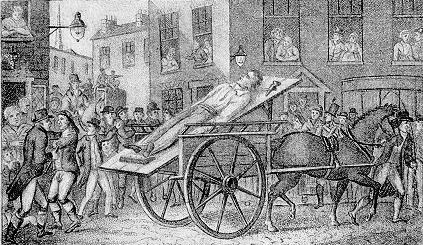
Williams was arrested but hanged himself before his trial. The inquest before J. Unwin esq returned a verdict of felo de se and so at midnight on 30th December 1811 John Williams body was processed by cart from Cold bath Fields to the crossroads of Cannon street and Cable street, pausing for a time outside Marr’s shop.


     At the crossroads in front of a huge crowd and 259 policemen Williams was thrown into a pit and a stake was driven through his heart, he was also covered in quick lime and buried. 

    Thomas de Quincey later wrote “and over him drives for ever the uproar of unresting London”. However, in 1911 the water board dug up this piece of road and disinterred Williams body, his bones went to an unknown destination but his arms went to the criminologist Professor Churton Collins.

    This article was very kindly published in “The Chronicles”, the magazine of the London Vampyre Group.